// Table of contents
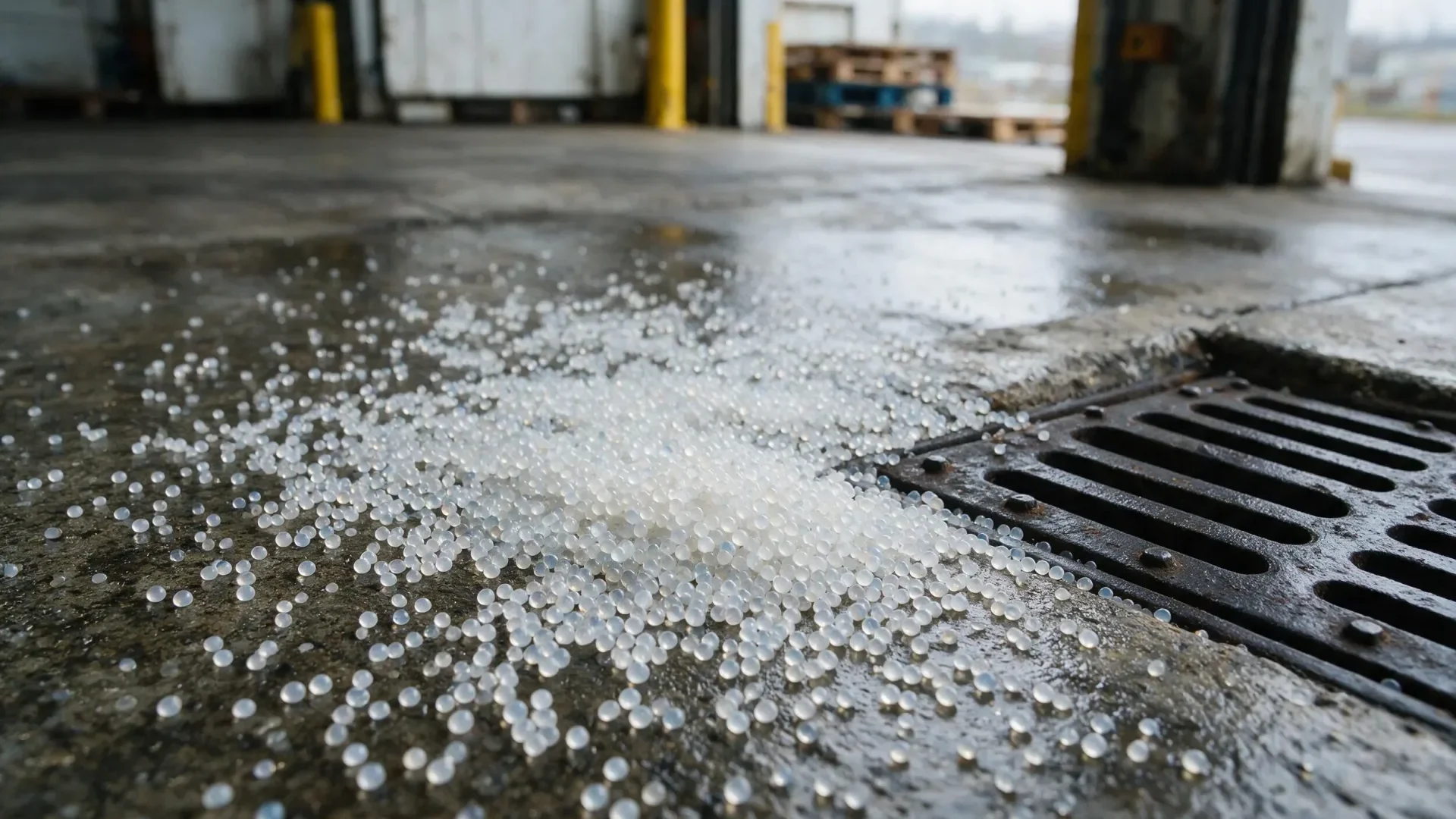
Plastic pellets are the smallest unit of the industry and, for years, one of its least controlled. They are lost during loading, transfer, cleaning and transport, and once in the environment they are effectively impossible to recover. The EU has now set rules: the regulation on preventing plastic pellet losses entered into force in December 2025, with most provisions applying two years later. Before that, one date already matters for planning — by 17 December 2026 the Commission is to produce awareness and training material and to request harmonised standards for estimating loss quantities.
Who the regulation applies to
The rules cover the handling of plastic pellets across the supply chain, not only their production. That includes producers, converters, logistics operators, warehouses and carriers — anyone through whose hands pellets pass in bulk.
The obligations scale with volume. Large and medium-sized companies handling more than 1,500 tonnes of pellets per year must obtain a certificate of compliance or a permit. Small companies and micro-enterprises face simplified requirements, and specific derogations and exemptions apply.
The core duties are the same regardless of size: avoid, contain and clean up any spills or losses, and establish and implement risk management plans tailored to the nature and size of the installation.
The compliance calendar
- 22 September 2025 — the Council signed off the regulation.
- December 2025 — the regulation entered into force, twenty days after publication in the Official Journal.
- 17 December 2026 — the Commission is to develop awareness-raising and training material and to request the European standardisation organisations to prepare harmonised standards for estimating the quantities of losses.
- Two years after entry into force — the majority of provisions start to apply, apart from specific derogations and exemptions.
The harmonised standards deserve attention. Until they exist, “estimating losses” is not a defined exercise — companies measuring their own spillage today are choosing their own method, and those methods will not necessarily survive contact with a European standard. Building a measurement routine now is useful; hard-coding it into procedures before the standard lands is not.
Why this is a recyclate topic, not only a virgin one
Nothing in the regulation distinguishes virgin pellets from recycled ones. A recycler producing regranulate handles pellets in exactly the sense the regulation means, and a converter blending recyclate into a product handles them too.
There is an operational asymmetry worth naming. Recycling sites often run more transfer points than a virgin polymer plant: material arrives as bales or flakes, goes through washing, extrusion and pelletising, and is then packaged in smaller lots for a more fragmented customer base. More transfers mean more opportunities for loss. The regulation does not penalise recyclers for that, but it does mean the compliance burden per tonne can be higher on a recycling site than on a large continuous plant.
What buyers can ask now
- Does the supplier exceed the 1,500 tonne threshold? If so, a certificate or permit will be required and preparation should already be visible.
- Is there a risk management plan, and does it cover loading and transport? Losses concentrate at the interfaces between operators, which is exactly where responsibility tends to blur.
- How are losses currently estimated? The answer is less about the number than about whether anyone measures at all.
- Do carriers fall under the supplier’s plan? Transport is where the material most often escapes and where contractual responsibility is most often unallocated.
Expected effect and its limits
The measure is expected to reduce pellet losses by up to 74%. That figure comes from the impact assessment underpinning the legislation, not from measured outcomes, and should be read as the policy expectation rather than a result.
It is also worth keeping the scope in proportion. Pellet loss is one pathway of microplastic release into the environment, not the only one, and this regulation does not address the others. It is a targeted instrument with a defined subject — which is precisely why it is one of the few microplastic measures with a concrete compliance calendar attached.
Frequently asked questions
Who needs a certificate under the pellet loss regulation?
Large and medium-sized companies handling more than 1,500 tonnes of plastic pellets per year must obtain a certificate of compliance or a permit. Small companies and micro-enterprises face simplified requirements, with specific derogations and exemptions.
When do the obligations start to apply?
The regulation entered into force in December 2025, twenty days after publication. Apart from specific derogations and exemptions, the majority of provisions start to apply two years after entry into force.
What happens by 17 December 2026?
By that date the Commission is to develop awareness-raising and training material and to request the European standardisation organisations to prepare harmonised standards for estimating the quantities of pellet losses.
Does the regulation apply to recycled pellets as well as virgin?
Yes. The rules cover the handling of plastic pellets throughout the supply chain and do not distinguish between virgin and recycled material.
Read next
- Post-consumer recyclate (PCR): what it is and how rPET, rHDPE and rPP are produced
- Food-grade rPET certification: EFSA, FDA, ASTM, ISO
- ISCC PLUS and mass balance: how the system actually works
Sources: European Commission, announcement of the entry into force of the regulation on preventing plastic pellet losses (16 December 2025); Council of the European Union, press release of 22 September 2025.