// Table of contents
Post-consumer recyclate (PCR) is plastic recovered from packaging that has completed its full life cycle with the consumer — bought, used and placed into collection. This separates it from post-industrial recyclate (PIR), which comes from manufacturing waste (off-spec batches, sprues, production trim).
For FMCG packaging producers the distinction matters. PIR is technically easier (known origin, no external contamination), but PCR is what actually closes the loop — only PCR returns from the consumer market. EU regulation (PPWR, SUP Directive) and ISCC PLUS certification count progress exclusively on PCR.
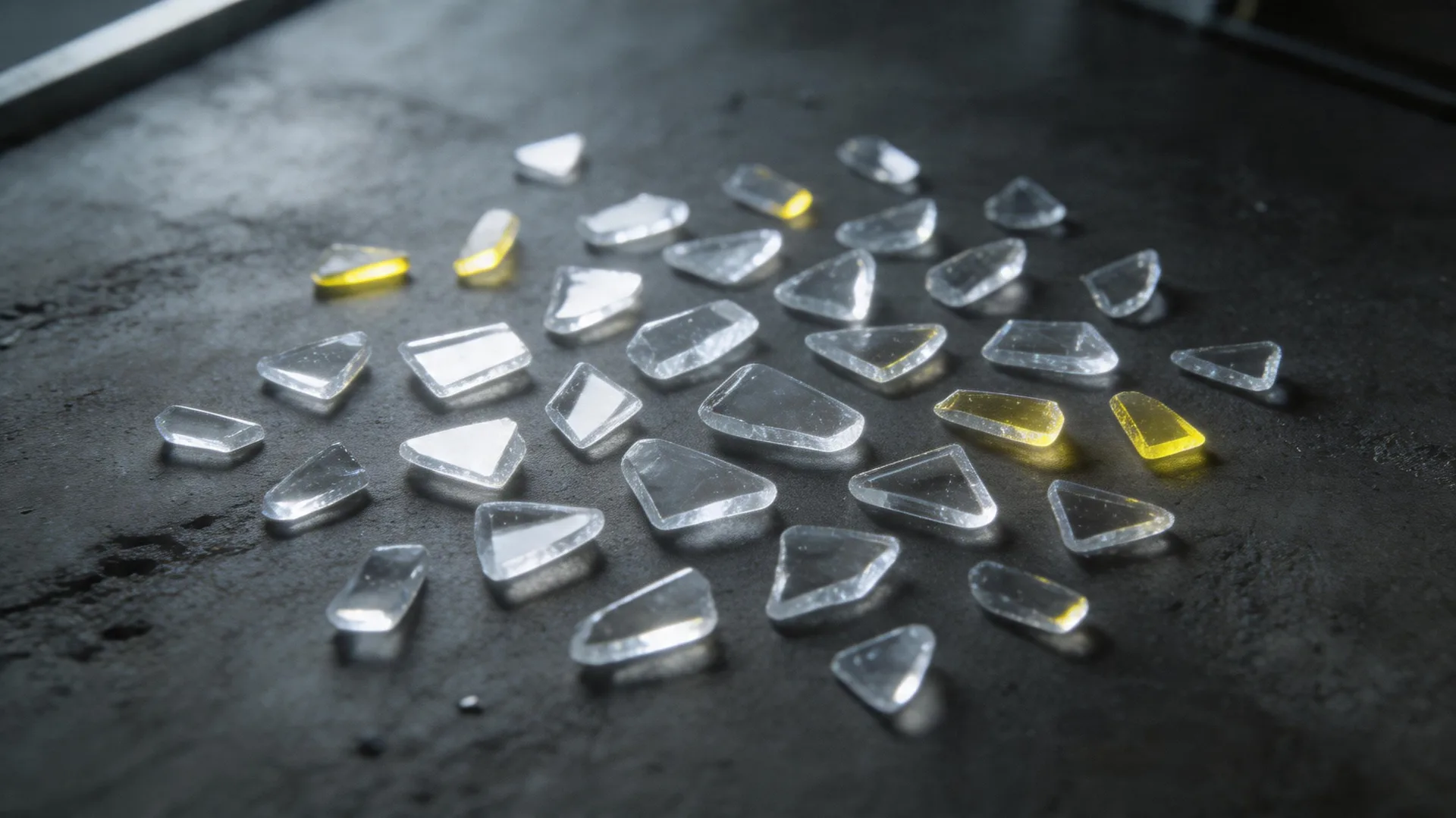
Three PCR polymers in the industry
rPET — recycled polyethylene terephthalate
The most important PCR segment. Mainly from beverage bottles — water, juices, carbonated drinks. Second stream: PET trays (salads, fruit, baked goods). Third: textile fibres.
- rPET food-grade — suitable for food contact, requires a Solid State Polycondensation (SSP) step and an EFSA-approved process. Price in Poland Q1 2026: EUR 1 440/t (pellet).
- rPET general purpose — non-food packaging, polar-fleece fibres, strapping. Price: EUR 780/t.
rHDPE — recycled high-density polyethylene
Mainly from milk bottles, shampoo and detergent containers. Stiff, chemically resistant, opaque. Uses: non-food bottles, pipes, pallets, park furniture. Food-grade rHDPE remains a niche — only 6 EU plants are approved for milk and dairy contact.
rPP — recycled polypropylene
From caps, household containers, technical packaging. Lower bulk-supply maturity than PET/HDPE — pricing more volatile, but applications (cosmetic jars, technical films) are growing rapidly with eco-modulation.
How PCR is made — six steps
1. Selective collection
Bottles reach a sorting facility via one of three channels: deposit return (DRS), municipal yellow bag, or in-store take-back. DRS produces the cleanest stream — the consumer pre-sorts and reverse-vending machines reject wrong items.
2. Mechanical-optical sorting
The MRF separates the stream into fractions. Key tech: trommel screens, ballistic separators (film vs 3D containers), NIR sorters (polymer ID via near-infrared), colour sorters (clear vs coloured PET). Modern facilities reach 96–98% fraction purity.
3. Shredding
Sorted packaging passes through cutting mills or rotary guillotines, producing flake 8–12 mm. Transported to the recycler in 300–500 kg bales.
4. Washing and cleaning
- Hot washing in caustic soda (85–95 °C) — removes adhesives, fats, organic contaminants
- Float-sink separation — by density (PET sinks, HDPE/PP caps float)
- Drying — to moisture below 0.1%
- Contamination detection — flake-level NIR sorters reject PVC, black plastics, metallic particles
5. Extrusion / pelletising
Cleaned flakes feed an extruder, melted (260–280 °C for PET) and pelletised. Filter screens (6–40 μm) catch residual contaminants.
6. SSP — only for food-grade
Solid State Polycondensation is the additional step for food-grade rPET. Pellets are heated to 200–220 °C in nitrogen at reduced pressure for 12–18 hours. It:
- Evaporates volatile contaminants (residual benzene, limonene, acetaldehyde)
- Raises polymer intrinsic viscosity (IV) to vPET level (0.78+ dl/g)
- Certifies the batch as EFSA food-grade compliant
After SSP the pellet is ready for new bottle production — the bottle-to-bottle step.
Certifications that matter
- EFSA food-grade — opinion of the European Food Safety Authority approving a specific recycler process for food-contact materials. No beverage brand buys without it.
- ISCC PLUS — global mass balance and traceability standard. Most common in Europe for rPET and chemical recycling. From Q4 2026 in v4.2 with stricter requirements (see our article).
- Operation Clean Sweep (OCS) — plant-level microplastic-loss standard. Often required by green public procurement.
National certifications (DIN CERTCO in Germany, AFNOR in France) complement the supplier compliance portfolio.
PCR uses in practice
| Polymer | Typical PCR content | Applications |
|---|---|---|
| rPET food-grade | 30–100% | Beverage bottles, food trays, thermoformable films |
| rPET general | 50–100% | Polar fibres, textiles, strapping, non-food packaging |
| rHDPE food-grade | 30–100% | Milk bottles, food-contact cosmetic packaging |
| rHDPE general | 50–100% | Chemical bottles, pipes, pallets, furniture |
| rPP | 20–50% | Cosmetic packaging, technical cups, films |
PCR in EU regulation
The 2024 Packaging and Packaging Waste Regulation (PPWR) sets mandatory PCR-content targets for packaging placed on the EU market:
- PET beverage bottles: 30% PCR by 2030, 65% by 2040
- Non-food PET bottles: 35% by 2030
- HDPE/PP non-food packaging: 25% by 2030
- Cosmetic packaging: 10% by 2030 (to rise)
Missing targets triggers compensation fees and market access restrictions (some categories will be phased out).
What PCR can’t do
- PVC — chlorine contaminates the recycling line
- Multilayer with EVOH, PA — needs chemical recycling, still scaling
- Carbon-black plastics — invisible to NIR sorters
- Soiled packaging (oil, fat, food residues) — only if rinsed
- Very small parts (caps, closures) — lost in screens
A typical Polish yellow-bag stream yields 30–45% usable recyclate. The rest goes to RDF or landfill. DRS lifts this to 94%+ — which is why it is strategic for closed-loop FMCG.
Summary
PCR is not an abstract ESG label — it is a specific polymer with a specific process, certification and market price. Understanding the differences between food-grade and general-purpose rPET, between milk-bottle and cosmetic rHDPE, between ISCC PLUS mass balance and physical segregation — that is the baseline competence for any packaging buyer in 2026. Without it, brand ESG commitments turn into compliance risk rather than strategy.