// Table of contents
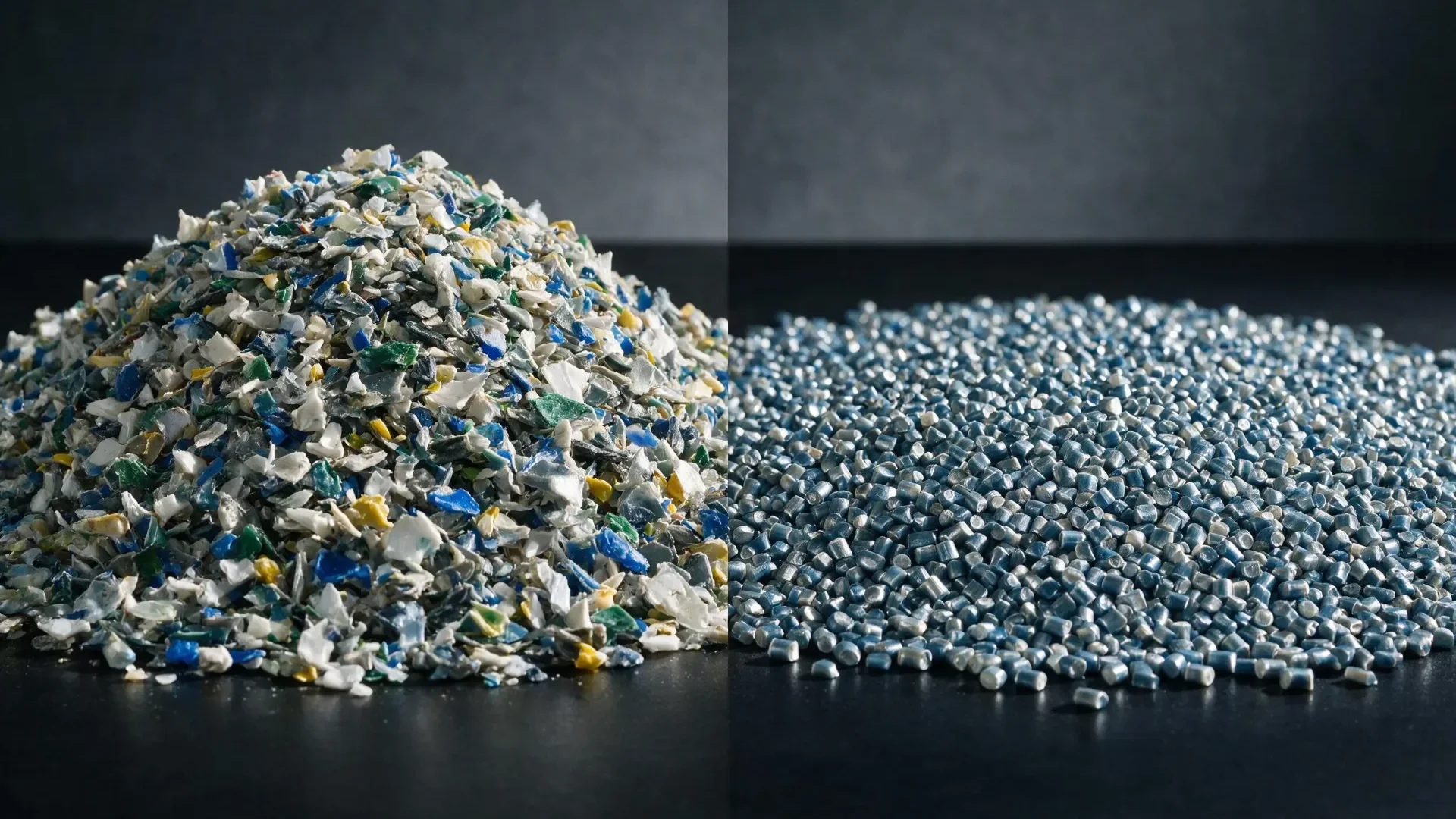
At what point does processed waste stop being waste and become a raw material? The answer determines the legal regime a batch of recyclate sits under, how it moves across borders, what permits a warehouse needs and who carries liability for it. Today the answer depends on the Member State, and sometimes on the interpretation of an individual authority. The European Commission wants to end that, and in December 2025 it tabled a draft implementing act establishing EU-wide end-of-waste criteria for plastics. Public feedback was open until 26 January 2026.
Where the problem comes from
The Waste Framework Directive already allows waste to cease being waste after a recovery operation, provided four conditions are met cumulatively: the substance is commonly used for specific purposes, a market or demand exists for it, it meets the technical requirements and product standards that apply, and its use will not lead to adverse environmental or human health impacts.
The difficulty is that the directive lets Member States set detailed criteria themselves where the Commission has not done so. The result is a patchwork. In one country regranulate leaving a given process holds product status; in another it remains waste until it is injection-moulded at the converter.
The consequences are measurable: different record-keeping obligations, different transport requirements, different documentation at the border, and different access to finance — banks find it harder to fund trade in waste than trade in raw material. For a buyer this means that comparing two offers from different countries is often not comparing like with like. The price per tonne may be close while the cost of executing the transaction is not.
What the draft covers
The proposed regulation covers mechanical and physical recycling of plastics — processes in which the polymer chains that constitute the plastic are retained. Its scope extends to thermoplastic polymers and blends of thermoplastic polymers, regardless of polymer type.
The critical exclusion: at this stage the draft does not take chemical recycling into consideration, nor other types of plastic. That distinction has practical consequences, because material from pyrolysis or depolymerisation would remain inside the waste regime longer than mechanical regranulate, even where the two are indistinguishable in the finished product.
The act forms part of the wider package the Commission announced in December 2025. The same package included rules on calculating and verifying recycled content in single-use PET beverage bottles under the Single-Use Plastics Directive, separate customs codes distinguishing virgin from recycled polymers, a relaunch of the Circular Plastics Alliance and market monitoring. The Commission also announced a Circular Economy Act as a broader horizontal measure for 2026.
What changes if it is adopted
Commercially. Harmonised criteria mean a batch meeting them loses waste status across the Union, not only in the country where it was produced. That simplifies cross-border trade and strips administrative cost out of transactions.
On quality. End-of-waste criteria typically come with requirements on contamination, quality management systems and documentation. Raising the bar removes from the market material that currently operates in a grey zone — good news for buyers, though in the first period it may mean less availability of the cheapest fractions.
On financing. Material with product status is easier to insure, to finance and to hold in stock. For recyclers working on thin margins that is not cosmetic; it can be the difference between being able and unable to carry a buffer inventory.
What it does not do
End-of-waste is not food-contact approval. These are separate regimes. Material can cease to be waste and still be unsuitable for food packaging, because approval flows from food-contact-material legislation and from the assessment of the recycling process.
It does not replace certification. Schemes such as ISCC PLUS or recyclability assessments answer different questions — about origin, mass balance, or design for recycling. Waste status answers only the question of which legal regime the material sits under.
It does not create capacity. Simplifying trade helps where material already exists. It does not change the fact that EU recycling capacity has been contracting rather than expanding.
How to prepare
- Map the legal status of the batches you buy. For every supplier, establish whether material leaves the plant as waste or as product, and on what basis. This is rarely in the specification and often in the contract.
- Check whether the supplier runs a quality management system matching the likely criteria. If so, the transition will be a formality. If not, that supplier may exit the market exactly when you need continuity.
- Separate mechanically and chemically recycled material in your portfolio. The two groups will be treated differently, and the difference will show up in documentation and logistics.
- Do not rewrite contracts against the draft. The act has not been adopted and its final wording may differ from the consultation version. A clause on adapting to changes in the legal framework is more useful than embedding specific criteria.
Why the Commission is acting now
The timing is not accidental. PPWR has applied since 12 August 2026 and sets recycled content targets for packaging. From 21 November 2026 the ban on exporting plastic waste outside the OECD takes effect, increasing the volume circulating inside the Union. A single market for secondary raw materials is a precondition for both mechanisms to function — without it, material stalls at the boundaries between legal regimes instead of flowing to where it is needed.
The Commission estimates that circular solutions could cut sector emissions by 45% and improve the trade balance by EUR 18 billion annually by 2050. Those are figures from the policy case for the package, not from any individual company’s business plan, and are best read as a statement of direction rather than a commercial forecast.
Frequently asked questions
Are EU end-of-waste criteria for plastics already in force?
No. This is a draft implementing act tabled by the European Commission in December 2025, with public feedback open until 26 January 2026. Until it is adopted, existing national rules continue to apply.
Does the draft cover chemical recycling?
No. It covers mechanical and physical recycling of thermoplastics, that is processes retaining the polymer chains. Chemical recycling and other types of plastic are not taken into consideration at this stage.
Does losing waste status mean the material is approved for food contact?
No. These are independent legal regimes. Material can cease to be waste and still fail the requirements for food packaging, which flow from food-contact-material legislation and from the assessment of the recycling process.
What conditions must waste meet to stop being waste?
The Waste Framework Directive requires cumulatively: common use for specific purposes, an existing market or demand, compliance with technical requirements and product standards, and no adverse impact on the environment or human health.
Read next
- Post-consumer recyclate (PCR): what it is and how rPET, rHDPE and rPP are produced
- ISCC PLUS and mass balance: how the system actually works
- Food-grade rPET certification: EFSA, FDA, ASTM, ISO
Sources: European Commission package on plastics circularity, December 2025 (IP/25/3151); draft implementing act on EU-wide end-of-waste criteria for plastics, public feedback to 26 January 2026; Waste Framework Directive.