// Table of contents
Ten weeks remain until 21 November 2026, when the EU ban on exporting plastic waste to non-OECD countries takes effect. Estimates put the volume that will have to be handled inside the Union at 500,000 to 800,000 tonnes a year. The question that matters between now and then is not whether the material stays — it will — but where it goes, given that European recycling capacity has been contracting rather than expanding.
Where the volume comes from
In April 2026 the EU shipped roughly 67 million kilogrammes of plastic waste to non-OECD destinations in a single month. That flow does not stop being generated on 21 November; it stops having somewhere to go.
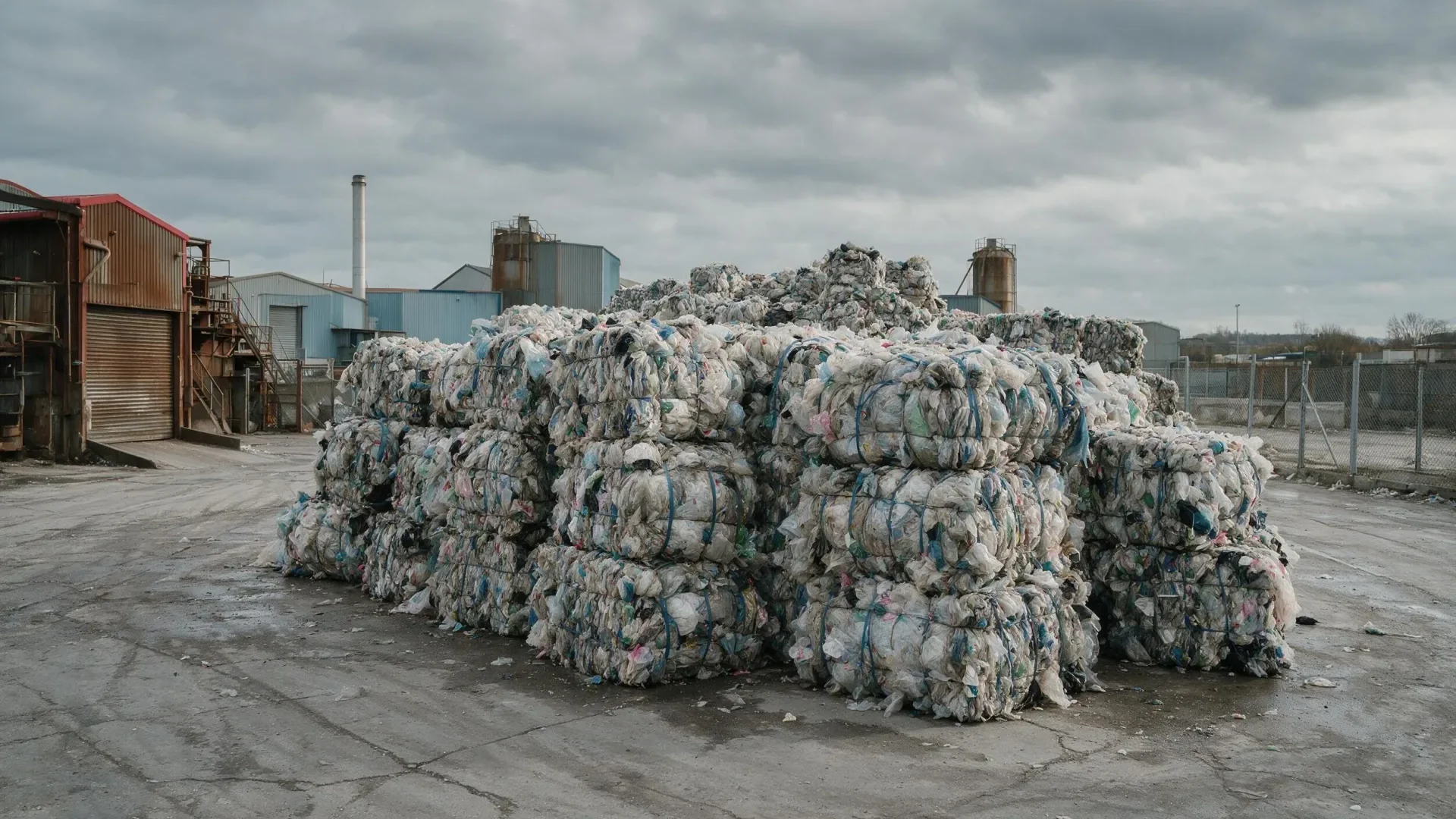
The composition matters more than the tonnage. Clean, homogeneous fractions found European buyers without difficulty and largely stayed. What was exported was mixed, contaminated material whose processing does not pay at current prices. Keeping it in Europe does not improve its quality. It increases the supply of waste, not the supply of usable recyclate — a distinction that gets lost in most commentary on this deadline.
The capacity side
EU recycling capacity stood at approximately 13.2 million tonnes in 2023 and lost around one million tonnes by the end of 2025 — the equivalent of France’s entire capacity, removed in two years. The cause is economic rather than regulatory: cheap virgin polymer, petrochemical overcapacity concentrated in China, and European operating costs that do not clear at current recyclate prices.
June’s assessments illustrate the squeeze. Black rPP pellets were assessed at EUR 960–970 per tonne, down 3.3% month on month, with demand weak across most recycled polymers. Adding difficult feedstock to a market where the processors of difficult feedstock are closing does not automatically produce recycling.
Three destinations for the displaced material
Mechanical recycling, for the part that qualifies. Some of what currently leaves Europe could be processed here with better sorting upstream. That is the best outcome and the least likely to happen quickly, because it requires investment decisions that today’s margins do not support.
Chemical recycling, in theory. Mixed, contaminated material is precisely what pyrolysis was designed for, and around 65 projects totalling some 2.8 million tonnes a year have been announced or are under construction in Europe. But installed operating pyrolysis capacity is roughly 150,000 tonnes a year, with over 300,000 under construction or commissioning — and Viridor closed three Quantafuel plants in Scandinavia while Plastic Energy entered administration. The gap between announced and operating is the whole story here.
Energy recovery, in practice. Without a price premium for lower-carbon polymer, an obligation to handle waste domestically leads to incineration rather than to recycling. This is the outcome the deadline makes more likely in the short term, and it is worth naming plainly rather than assuming the regulation will produce circularity on its own.
What to do in the remaining weeks
- Establish your suppliers’ exposure. A recycler balancing its books on off-spec sales outside the OECD loses that channel in November. Ask what share of revenue it represents and what the plan is.
- Review 2027 contracts around feedstock origin, not only specification. Specifications can be met temporarily; access to feedstock is structural.
- Expect gate fees for reject fractions to rise. Whatever happens to recyclate prices, the cost of disposing of what cannot be recycled is going one way.
- Check that shipment documentation runs through DIWASS. The digital system has been live since 21 May 2026, and suppliers who handled that transition cleanly usually have the rest in order.
What comes after
21 November is not the last date in this file. From 21 May 2027, stricter rules apply to exports of non-hazardous waste to non-OECD countries, tightening the remaining routes further.
The measure that would change the economics rather than only the logistics is on a different track: harmonised end-of-waste criteria for plastics, consulted on until 26 January 2026, which would let qualifying recyclate move across the Union as product rather than waste. Until that lands, the November deadline redistributes material without changing the reason it was leaving in the first place.
Frequently asked questions
How much plastic waste will have to stay in the EU after 21 November 2026?
Estimates put the volume at 500,000 to 800,000 tonnes a year. In April 2026 alone the EU shipped roughly 67 million kilogrammes of plastic waste to non-OECD destinations.
Will the ban increase the supply of recyclate?
Not directly. Exported volumes were largely mixed and contaminated fractions that European plants do not process profitably. The ban increases the supply of waste rather than of specification-grade recyclate.
What happens after the November 2026 deadline?
From 21 May 2027 stricter rules apply to exports of non-hazardous waste to non-OECD countries. Separately, harmonised EU end-of-waste criteria for plastics remain in draft following consultation that closed on 26 January 2026.
Read next
- Chemical recycling in Europe: pilot and commercial plants
- Post-consumer recyclate (PCR): what it is and how rPET, rHDPE and rPP are produced
- ISCC PLUS and mass balance: how the system actually works
Sources: Regulation (EU) 2024/1157 on shipments of waste and its application timeline; export volume and capacity figures from market analysis published in July 2026; EUWID survey of European chemical recycling projects (October 2025); OPIS price assessments, end of June 2026.