// Table of contents
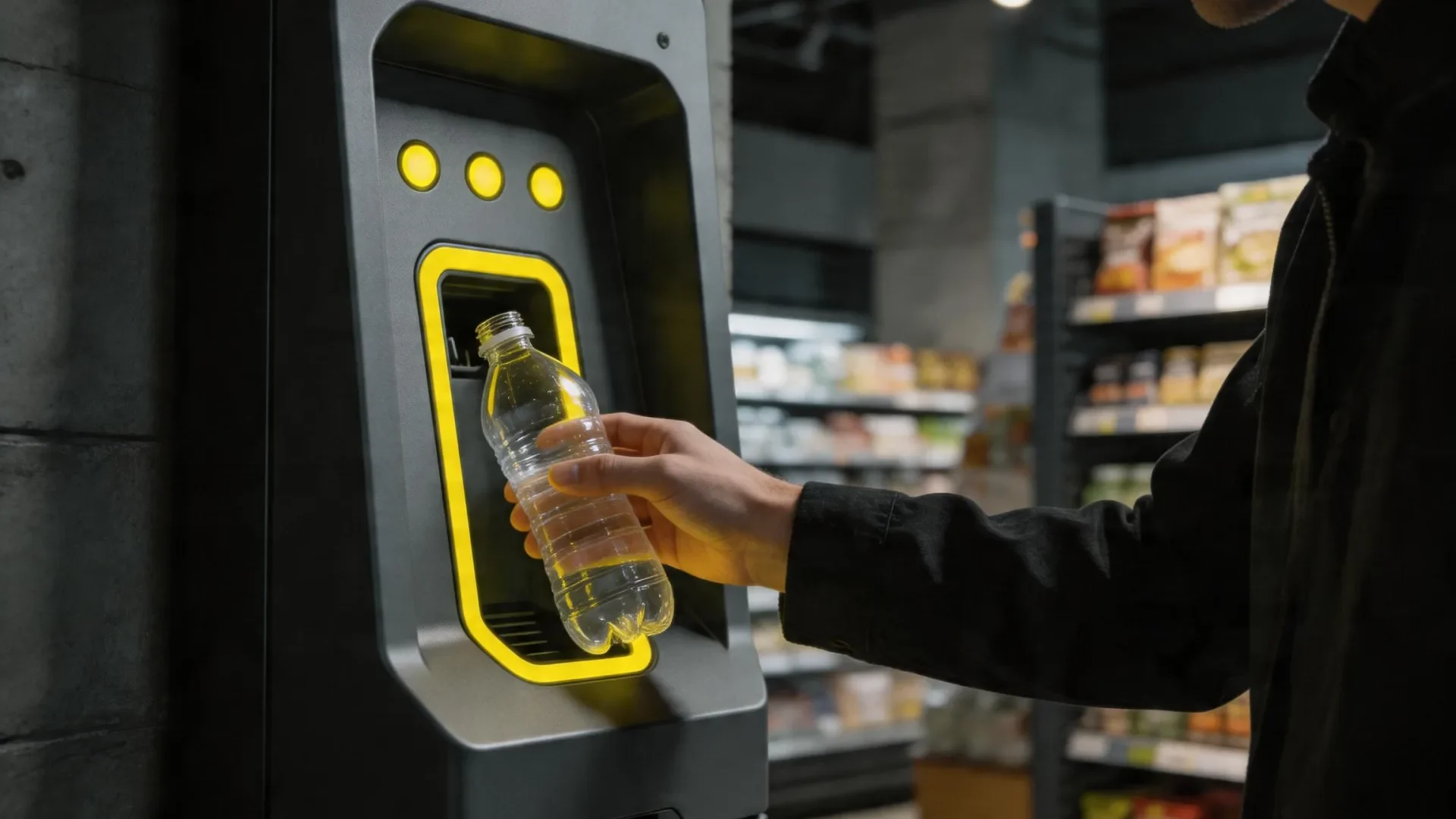
Poland’s Deposit Return System (DRS) has been operating since 1 October 2025. Six months later, the Ministry of Climate and Environment, together with the central operator Polska Organizacja Kaucyjna, published the first complete report — 186 pages of data from all three reverse-vending operators (Tomra, Envipco, Remondis) and 11 major retail chains.
Results are better than forecast on returns and worse than expected on municipal sorting. The food-grade rPET segment is the main winner; comprehensive municipal MRFs are the casualty.
Numbers — as of 31 March 2026
| Indicator | 2026 target | H1 result | Status |
|---|---|---|---|
| PET bottle return (up to 3 L) | 65% | 72.4% | ✓ above target |
| Aluminium can return (0.33–1 L) | 70% | 81.1% | ✓ above target |
| Refillable glass return | 55% | 59.8% | ✓ target |
| Recyclability of returned PET | 90% | 94.2% | ✓ above target |
| Wrong items in machines | < 5% | 3.1% | ✓ target |
| PET in municipal yellow bag | steady | −11.3% | ✗ drop |
Translation: deposit bottles come back in far higher numbers than forecast. At the same time, the most valuable packaging is disappearing from the municipal yellow bag — because it now goes into the machines instead.
Why MRFs are in trouble
The PET bottle was the economic anchor of the municipal stream. A tonne of sorted clear PET from the yellow bag fetched PLN 2 200–2 800, which paid for sorting and funded the harder fractions (coloured PET, PP, PS). After DRS that revenue dropped by ~18% — simply because fewer bottles arrive at the MRF.
At the same time, the quality of what remains has worsened: oddly-shaped bottles, non-deposit chemical containers, residual films, caps and household residues. For an MRF that means higher operating cost per tonne against falling revenue per tonne.
Seven of 42 MRF operators in Poland reported negative operating margins in Q1 2026. Two suspended selective PET sorting lines and switched to RDF (refuse-derived fuel). Three announced investment in higher-grade optical sorters to monetise fractions formerly considered “difficult”.
rPET markets — price jump
The second effect is a structural shift in food-grade rPET supply. DRS delivers high-quality material (pre-sorted, known provenance, no cross-contamination) — the preferred feedstock for bottle-to-bottle recyclers.
Average food-grade rPET prices in Poland, Q1 2026 vs Q4 2025:
- rPET flake food-grade (from DRS): EUR 780/t → 920/t (+18%)
- rPET pellet food-grade: EUR 1 240/t → 1 440/t (+16%)
- rPET mixed flake (yellow bag): EUR 460/t → 420/t (−9%)
The quality premium is widening. Recyclers who can separate the deposit stream from the municipal stream and produce food-grade material now run 40–50% higher margins than two years ago. Pure “general purpose” rPET producers see margins decline.
What this means for FMCG
Two operational takeaways for packaging procurement at FMCG groups:
- Food-grade rPET availability is rising. Poland — alongside Czechia, Slovakia and Romania, all rolling out DRS in 2026–2027 — is shifting from importer to exporter of this material. Companies with 30–50% rPET commitments for 2030 can already import from Poland in 2026/27.
- But price rises faster than volume. Long-term contracts are the new advantage. Spot is becoming expensive and seasonally sensitive.
Plans to expand DRS in 2027
The Ministry has announced consultations on adding:
- PET bottles up to 3 L for edible oils (currently outside DRS)
- HDPE bottles for milk and dairy (pilot 2027)
- Tetra Pak cartons (consultation — technically harder because of multilayers)
If all three are added, Poland reaches DRS coverage similar to Germany’s (~85% of beverage packaging) by 2028. That further pushes municipal MRF economics towards remaining fractions — films, cosmetic packaging, low-volume engineering plastics.
Summary
DRS in Poland is performing better than expected on collection. The problem is elsewhere — in the economics of the traditional MRF, which is losing the most valuable part of its feedstock. Slowing DRS is not an option (the Brussels clock keeps ticking — PPWR 2030 targets are explicit); the answer is reconstructing MRF financing. The Ministry has signalled a new EPR tranche for the 2027 budget.
For FMCG brands, 2026 is the year to lock in long-term food-grade rPET contracts. After 2027 they can only get more expensive.